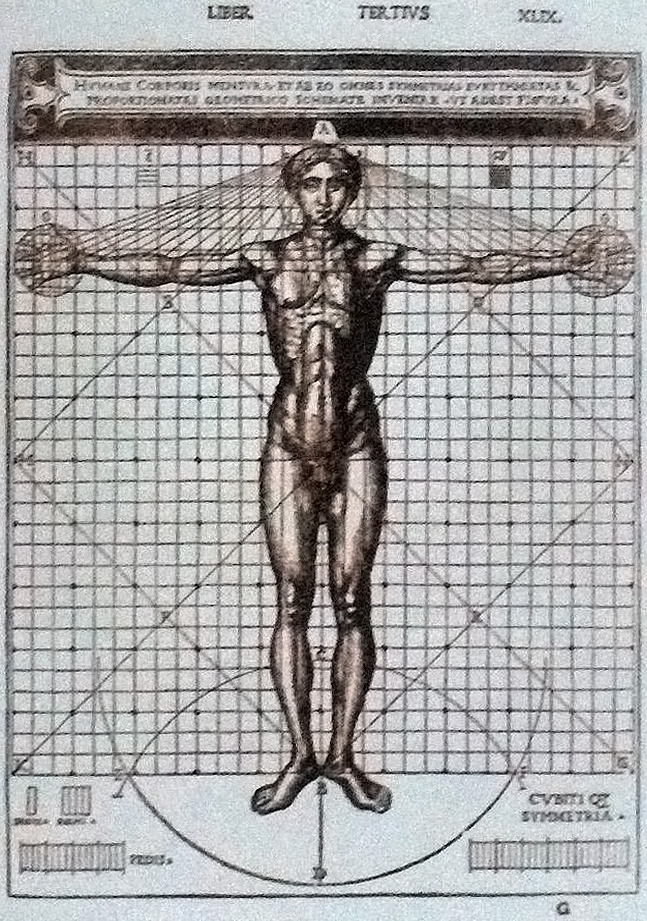
Marcus Vitruvius Pollio (b. 50-60 BC, Roman Republic – d. 15 BC)
De Architectura, 30-15 BC
In his treatise on architecture, Vitruvius used the human body as a model for proportions. Who knows whether it was his innovation or just articulation of then already prevalent view. And I am in no way in a position to assess how this idea – through its centuries long impact on built environment and scholarly thought – may have framed and pre-disposed my own thinking. However, I find it very useful to keep reminding myself that whatever we humans do or perceive is framed by affordances and limitations of the human body. Be it scale or materiality or possible modes of engagement.
And still, each body is different, so even if artist may have to work from their own body as a base, or target some relevant “statistical average”, individual variations within the audience are bound to result in a variety of perceptions and impressions. I guess, this inescapable mismatch between the views available from the positions of maker and the viewer – condition by differences in bodies, in reference frameworks, even in time – is what fuels a lot of my practice. One could also talk in terms of subject position, but Vitruvius is older and more body-centred, which fits my purposes here.
I put something out, and even if the object may stay seemingly the same, I keep extracting new meanings upon each encounter with it. And so does every member of the audience, unless they are conditioned to quickly box and seal their impressions – which they often are. I am equally confused and fascinated with this human propensity to try to conserve things in an ever-changing world. That emerges as yet another recurrent topic of my explorations.
And yes, I have made a mixed media piece “Imperfect Man as Perfect Measure” where I was tracing my body on the canvas, then projecting on it a video of myself trying and failing to re-assume those same positions. That piece has a very direct connection to Vitruvian Man. In other works it is not at all that visible, but nevertheless always present in the traces of the particular body that shaped it and senses of the body perceiving it.
 s3685049