Unknown artist
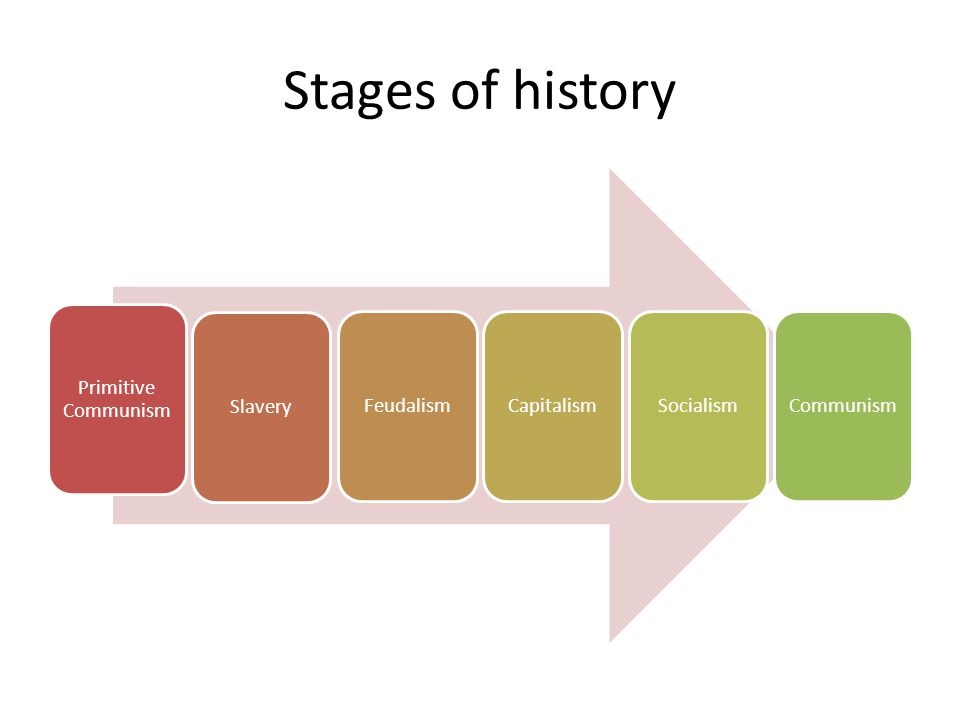
Stages of history according to Marx & Engels presented as facts
My classroom at the primary school was decorated with a large mural depicting stages of history roughly as they are outlined in the image above. However, it was hand-painted as a pretty evolutionary tree of sorts. Not enough that we were taught all that as unquestionable facts of life, it was also artistically represented as something “natural”. There is no way of knowing who the artist was – and would it really matter, as he or she was only encoding given “truths” following a given code book.
I don’t know for sure how I came to think of that mural – that I cannot locate any original image of – in this context. Perhaps it is a result of continuous thinking of “genealogy” of my practice that this blog is supposed eventually lead to – along with my recurrent articulation of stances against generic truths, aesthetisation of ideology, mix-up of chronology with causality and a number of other vices that I keep encountering in the artworld.
Fool me once, shame on you; fool me twice, shame on me. And I’ve been fooled, alright. Artistically conveyed “facts of life” turned out to be wishful thinking at best – if not a deliberate fraud. Genealogy is not a guarantee for any particular future. Chronology does not vouch for causality. Nicely drawn lines, symmetrical structures or photorealistic renditions do not vouch for the validity of the message.
So what does it mean to “design genealogy of my practice”? I rather like the word “design” here – at least it does not require any “truth” to be revealed, it only requests an artefact to be made. But does it still assume a chronology and a straight line from the olden times branching out into contemporaneity until it leads to “my practice” hanging on a fresh tiny branch as a lovely red apple? But what if “my practice” is not a coherent entity at all, but various strands of more and less enmeshed curiosities? And even more importantly – what if “my” being the thinker and/or the maker of the works in “my practice” does not really matter? If I care more for what meanings they trigger in others? There is no way to even sketch such a genealogy – and yet it would be so much more meaningful in my view.
And even if doomed to such ego-centric genealogy, which chronology should matter most – in which order things were made, in which order I came to be aware of them, or in which order they were undergoing my sense-making of them? Is a work made before I was even born necessarily a meaningful predecessor to something that I have made before even becoming aware of it? And what if I “borrow” from a historical work something else than it is known for? Is it still the date of its creation or the extraction date of my idiosyncratic meaning that is most relevant? I can surely deduct a bunch of conventional answers here… but how much do I want to contribute to reproduction of a convention that I am so keen to re-articulate?..

