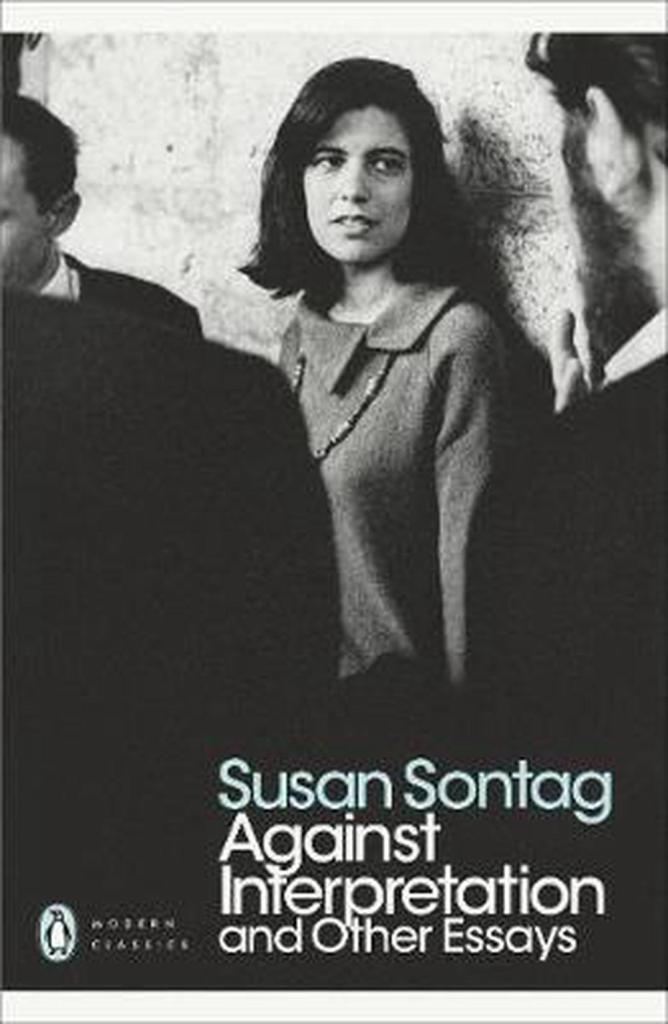
Susan Sontag (b. 1933, USA – d. 2014, USA)
Against Interpretation, 1964
“The modern style of interpretation excavates, and as it excavates, destroys.” (Sontag 2009, 6)
Sontag’s essay from 1964 is brilliant and reflects to large extent my stance today, especially when it comes to criticism of interpretation as a way of re-making the work to fit the interpreter’s agenda based on a particular ideology, value system or theory.
The problematic bit is Sontag’s remedial suggestions. All art cannot become films. And pure description of formal qualities can also be seen as a very reductive interpretation. Today I am trying to resist this formalistic view as well when all artworks are submitted to nearly scientific deconstruction in terms of dimensions, materials and physical properties. That’s hardly “erotica” Sontag called for, possibly “pornography”.
I am playing with idea of considering what the artwork enables instead. Certainly, it may enable both weird Freudian or Marxian interpretations as well as pornographic formal deconstruction. But enabling does not necessarily enforce anything, thus the viewer is free to consider which among all the affordances of the work that may be more appropriate for their personal needs and pleasures… I am not sure this will lead to any better place than the previous attempts, but at least I am trying…
 s3685049
Huh? What? An artwork “enables” “interpretations”. Hopefully art has something of its own to say, and interpretations constitute how far adrift the audience is from the real content.
LikeLike
“Real content” is a problematic concept. Surely, it does exist in terms of formal qualities and materials that objectively constitute the piece. But in terms of meaning there is nothing “real” in that sense, everything is a matter of interpretation and negotiation of meaning that may involve the artist, the viewer, the work, the critics, the language, the context of viewing etc. I think any stable “real content” can only exist in very special cases where the artist and the viewers share and follow strict conventions, like in propaganda art or religious art. But sure, you can insist that artist’s intent is always the “real content” of the artwork – if that’s what you mean. But from my perspective I would only see that as your preferred definition of “real content” (which is not unreasonable) and not as some “objective truth” as I tend to revel in idiosyncratic readings of the works without caring too much about artistic intents that sometimes may align with my readings and sometimes not. And in my own practice I often make works without any idea of “content”, letting contents emerge upon my interaction with the piece once it’s done, or letting the audience “to tell me” what it was about…
LikeLike
“Real content” is not “problematic” unless you have convinced yourself that reality only exists in text, and is entirely subjective and relative. There are so many holes in the philosophy of Roland Barthes and the postmodernists that they are in the end as ridiculous in their overstatements as they seem on the front side. It is true that there’s always an element of interpretation, and everyone is coming from different vantage points, but if there were not sufficient overlap, we wouldn’t even be able to communicate with one another. Not only do words have shared meanings, so do sentences, simple ideas, whole paradigms and belief systems. Science – which is enabling this conversation online and via computers – succeeds because of rigorously reliable constants in the universe, which are measurable and consistent in their operation (the law of physics, etc.). While it is true that there is always a level of subjectivity and relativism in art and art appreciation, it is absolutely false to grant arbitrariness to the bulk of art and audience assimilation of art. It is also backwards to make the audience more important than the artist in defining the meaning of a work of art.
As with postmodernism in general, it takes something that is 10-15% true, and treats it as if it is 100% true, and always goes against the grain of what is generally held by “common sense” to be reality. The end result is people are 85% wrong when they assign 100% truth to a claim that is only 10-15% true, at best.
You wrote, “I tend to revel in idiosyncratic readings of the works without caring too much about artistic intents”. Surely that’s what you were or are being taught, and is what I was taught as well in graduate art school. However, this cancerous view subordinates art to politics, usually, and pseudo-philosophical gobbledygook. Yes, the postmodernist are a bit full of shit, which is the unenviable and inevitable consequence of only being able to establish yourself as a ground-breaking philosopher by going against whatever is generally accepted, even if by the late 20th century we had a very strong foundation of what was generally true. You’ve adopted a devil’s advocate, anti-art, anti-enlightenment, anti-artist, anti-skill, anti-imagination, anti-talent, and doubtlessly anti-white belief system, in case you hadn’t noticed those bold outlines. Surely you consider Duchmap’s urinal one of the crowning achievements of art of the last century.
You’d be wise to dump the entire belief system, or take is with a huge grain of salt. It is cancerous, and it will take a good long time for you to deprogram yourself. Let me give you an analogy. Postmodernism did a necessary corrective, the equivalent of saying that all mammals give live birth is in fact wrong because platypuses lay eggs. That 15% truth is valuable. But what has happened is the equivalent of declaring that all mammals lay eggs. That is what your view of art is. You’ve taken the objection to a general truth, and crowned it absolute truth. Thus, it is absolutely true and real that there is no “real content”. Reality, for you, is absolute in the conclusion that there is not reality, and that conclusion is merely a sentence structure in linguistics. Postmodern thought invalidates itself, which you would discover in a very close reading of Roland Barthes. How can you accept the meaning of the philosophy which states that there is no meaning?
It’s sophisticated-sounding bullshit on a platter, and ultimately about 85% nonsense. And when art is subordinated to not only politics, but philosophy and even linguistics within the art community, artists should be fighting back, not accepting subservience and subordination of their work and content to obscurantist and selfish-self-interested political agendas.
It’s utter bullshit. The sooner you flush it down the better off you will be.
LikeLike
Thank you, I love the passion in your words, it’s invigorating! However, you have extrapolated my stance to absurd extremes. My impression is that you are representing the dominant majority against which I am staging my tiny rebellion, myself feeling rather lonely as I mostly find like-minded strategies in the middle of the last century. Thus, I am hopelessly out of fashion, although there may be different contemporary environments that I am not aware of. And I am definitely not trying to overshadow “the objective truth” of the 90% with my 10% of “relative truth”, I don’t want everyone to think like me, that would be unbearable.
So no, I am not questioning intersubjectivity without which we would not be able to communicate, but I do not want to push it into mass uniformity either. And here my question is – if art is only about delivering “real content” the way you describe it, isn’t it being reduced to just “language”, communication system, a tv of sorts? If I have that “real content” I want to share – why shouldn’t I just spell it out, shout out, write a letter, place an ad? Why should I invest the effort to “code” that into an artwork with all the risk of the audience decoding it “wrongly”? And if you would counter that art is there to say things that cannot be expressed in words, then you once again open for relativity, as without words you would not have same control of intersubjectivity. How would you know if I experience “the real content of green” in your painting the same way you meant it if that real content is unverbalisable, and all you know, I might even be colour blind…
I have no problem with artists realising their visions or communicating messages through art, I quite enjoy many of them and have no interest whatsoever to stop them. But I am also interested to see what may be overlooked following that convention, what other possibilities, insights and experiences could be gained outside of it. However, it is not my church, I am not trying to convert anyone, just sharing my interest in case anyone would be interested, too. It might also be just a phase, a phase needed to understand why the convention is the way it is and why it is soo good. Who knows. Anyway, I find it more interesting to exchange and consider opinions that differ than just to take part in a choir of consensus indefinitely replicating shared “truths”. Therefore I greatly appreciate your response!
LikeLike
You wrote: “My impression is that you are representing the dominant majority against which I am staging my tiny rebellion”.
Quite the opposite. Your stance is the dominant stance taught in art school (if it has a contemporary fine art focus) for at least the last 3 decades. I am well versed in it myself. I got an “A” in my “Art Theory” course at UCLA, for example. I was fully indoctrinated into the belief system in graduate school. You use the buzzwords like “practice” instead of art-making, and you argue textbook postmodern conclusions about the nature of reality being entirely subjective. I may be “extrapolating”, as you say, but you do have all the symptoms of being indoctrinated into the postmodern/conceptual/identity-politics belief system.
You wrote, “if art is only about delivering ’real content’ the way you describe it”. This is a “strawman argument”. I never said any such thing, and note your introduction of the word “only” into a position you falsely attribute to me. I stated that there is “real content” that exists independent of the subjective and relative assimilation that takes place in the mind of the audience. That doesn’t mean that there is ONLY real content, or that the purpose of art is ONLY to deliver that content. It means that real artistic content can and does exist. THAT is the argument you need to counter.
You wrote, “isn’t it being reduced to just ‘language’, communication system, a tv of sorts?” Not at all. Visual language is not the same thing as linguistics. It is a different language. For example, it doesn’t unfold in time, and it can cross verbal language barriers. You might appreciate that people who are part of western culture, but speak different languages, could potentially easily assimilate an image regardless of the language spoken by the artist. This also happens internationally. In that way you can see that it operates outside of linguistics and linguistic structures.
You wrote, “If I have that “real content” I want to share – why shouldn’t I just spell it out, shout out, write a letter, place an ad?”
Quite simply because that real content is not an idea in linguistics. Let’s say our work of art is a piece of music, say Beethoven’s piano sonata, “Appassionata”. The music is itself the “real content” in its own language. There’s needs be no interpretation in linguistics. That would be to miss the point entirely. If you were to “spell out” or “shout out” or “write letter” to reveal the content of the sonata, there were be no music in it. You seem to have fallen for the conceptualist notion that the purpose of art is to “ask questions” or “start a conversation” or “persuade (politically, usually” or “express an idea”. The sonata isn’t “asking questions” or “starting a conversation” or “persuading” or “advancing an agenda”. All of those are linguistic functions. Music is the most obvious example of the absurdity of defining artistic meaning only in terms of verbal or written language, but it easily applies to painting, and virtually every other art form that doesn’t actually try to convey a linguistic idea by being a prop.
You wrote, “Why should I invest the effort to “code” that into an artwork with all the risk of the audience decoding it “wrongly”? Again, there is no coding or decoding, the artist is not translating linguistic ideas into visual form.
You wrote, “And if you would counter that art is there to say things that cannot be expressed in words, then you once again open for relativity, as without words you would not have same control of intersubjectivity.”
You need to grant that there is cognition, understanding, and communication that is non-verbal. To say that art can only be specific if it is in words is as goofy as to say that cuisine can only be appreciated in its specificity with words. The difference between this or that recipe for a curry would only be a concern regarding the printed recipe, not the relishing of the food in question. Art is not in the service of linguistic communication any more than cuisine is, and it can be highly specific completely independent of words. To go with our cooking analogy, imagine you have an international meeting of chefs who have no shared language. They can still share recipes and taste each other’s food merely by showing the ingredients, and offering a place of their creation. No words need be used at all, and yet the engagement might be all the more highly specific for just that reason.
You wrote, “How would you know if I experience “the real content of green” in your painting the same way you meant it if that real content is unverbalisable, and all you know, I might even be colour blind…”
One of the ways to know if someone genuinely appreciates a work of art is if they like it. Simple but true. I listen to a lot of really eclectic music from around the world, and sometimes it takes several listens for something to gel. I’m a huge fan of, for example, Qawwali music, which comes out of Pakistan and from the mystical Sufi religion. I saw a few live concerts in NY before 9/11, after which the musicians couldn’t get visas to perform in America. I digress, but the point is that what the music conveys is highly specific, of a spiritual nature, and no, I can’t put it into words. Words can’t do the same thing. Music and visual art can do things words can’t. The fatal error – and it’s an insipid one as well, no matter the sophistication of the jargon – of the conceptualist/postmodernist approach to are is that it subordinates all art to linguistics. It sees all communication, no matter how powerful, only through its own lens and by its own limitations.
It’s the equivalent of judging apples and bananas only by the criteria of what constitutes a good orange.
You wrote, “I have no problem with artists realizing their visions or communicating messages through art.” The art is the message. It doesn’t need to communicate an idea, nor does it need to be interpreted in linguistics.
You wrote, “But I am also interested to see what may be overlooked following that convention, what other possibilities, insights and experiences could be gained outside of it.”
This sounds so broad-minded when it’s the opposite. It’s like saying, “What other uses can I have for this vinyl disc than to listen to the music?” It can be a plate! A Frisbee! I can burn a message into it using a magnifying glass. And instead of listening to the music to fathom the artist’s intent, why, you could play with projecting multiple interpretations on it according to one or more ideologies or belief systems. The music is no longer the artists expressing something, but is a mute object on which we can project whatever we want.
Instead of listening to the music, we are busy talking over it, and for some, that’s the real point of music. Pardon me, but I would much rather listen to it, and get something from it that is in the language of music, that resonates in a way that written language can’t, and has as little to do with politics, belief systems, ideologies, and so on as it chooses.
“However, it is not my church, I am not trying to convert anyone.” Sadly, from my perspective, it is a church, and you’ve been converted. It’s more a cult. I was indoctrinated into the same one. I’ve had more than a quarter century to think my way through it, and ultimately came to the conclusion that it’s utterly toxic. Generally, the whole belief system of which it is part, is, as I said, 10-15% true, and thus 85-90% false. It’s valuable to learn the exception to the general rule – in which case one can get closer to 100% truth (obviously impossible, but just for argument’s sake) but it’s ultimately self-abuse to convince oneself that the exception is the absolute rule. That’s what the conceptualists, postmodernists, and their ilk have done not only to themselves, but to the art world, and to legions of artists.
It’s anti-art and anti-artist. Somehow that’s supposed to be a good thing for art and artists, but, no, it’s poison.
LikeLike
You are expressing a highly polarised worldview – it’s either art or anti-art, right? For me it oozes of identity politics – to define a position as identity that necessarily comes with preset collection of “inherent features”. You are either with us or against us, you have to pick sides – and if you refuse, you are against us. I am sick and tired of identity politics, I prefer to approach the world in a more nuanced way. I am also protesting the overly linguistic take on art – all the way to avoiding to speak in terms of “artistic language”, “visual language” or “art as language” altogether as I cannot see how it can mean anything else than coding/decoding, no matter if the code is based on conventions about words or conventions about colours or conventions about strings communicating “love” in movie soundtracks etc. It boils down to conventional symbols of whatever kind they may be. Without them you cannot achieve intersubjectivity or communication, right? Yet at this point I find it too reductive to think about art in terms of communication alone and therefore trying to oppose that. So, where would my opposition to identity politics and excessive linguistics place me on your map?
But, more interestingly, could you elaborate how you understand “real contents” of art? I am becoming unsure whether we understand that phrase in the same way – language is treacherous.
LikeLike
You wrote, “You are expressing a highly polarised worldview – it’s either art or anti-art, right?”
Wrong. Anti-art holds a polarized view and positions itself against what it views as traditional art. Duchamp famously – as you learned in your art classes – declared Impressionism “too retinal” (which merely demonstrates his inability to fathom it in all its dimensions). I consider anti-art a kind of art.
You quite likely believe that conceptual art is on the defensive. Au contraire, it’s on the attack, and represents the dominant institutional paradigm. For example, Joseph Kosuth once said, “Being an artist now means to question the nature of art. If you are making paintings you are already accepting (not questioning) the nature of art.” Therefore, a painter is not an artist. Art critic for the Guardian, Jonathan Jones, opined, “Painters who know how to paint are relics from another world”.
Here’s Marcel Duchamp, “I don’t care about the word ‘art’ because it’s been so discredited, and so forth… I really want to get rid of it, in the way many people today have done away with religion.”
So, who or what paradigm is eliminating the competition and declaring some art to be non-art, or not relevant art (based on medium)? You can say I oppose the polarization of art, and war on art, that anti-art represents.
You wrote, “For me it oozes of identity politics – to define a position as identity that necessarily comes with preset collection of “inherent features”’.
What? It is ‘identity poitics’ to not buy into anti-art? Sorry, it’s the other way around. Both are narrow ideologies which oppose western civilization.
You wrote: “I am also protesting the overly linguistic take on art – all the way to avoiding to speak in terms of “artistic language”, “visual language” or “art as language” altogether as I cannot see how it can mean anything else than coding/decoding”.
It is not a linguistic take on art to speak of “visual language” as being separate from linguistics. What?
You wrote, “It boils down to conventional symbols of whatever kind they may be. Without them you cannot achieve intersubjectivity or communication, right?”
Good artists leave off the cliches and “conventional symbols”.
“Yet at this point I find it too reductive to think about art in terms of communication alone and therefore trying to oppose that. So, where would my opposition to identity politics and excessive linguistics place me on your map?”
Seems like you are doing a lot of opposing, but you are not “anti”?
“But, more interestingly, could you elaborate how you understand “real contents” of art? I am becoming unsure whether we understand that phrase in the same way – language is treacherous.”
You’re asking me to explain it in linguistics. Here, just do it. I invite you to listen to Beethoven’s “Aapassonata” and see if you can tell what the content might be. You only need a few minutes of it. You will either be able to tell what the content of art is, or not. There’s no explanation to understand. https://www.youtube.com/watch?v=0Ak_7tTxZrk&t=330s
LikeLike
And if you’d like a different musical example, try Hukwe Zawose: https://www.youtube.com/watch?time_continue=158&v=UDKLceUsLWA&feature=emb_logo
Can’t understand a word he’s saying and don’t need to. A very different substance than the Beethoven. Both pieces of music are rich with artistic content that is NOT up to the audience to decide what it is. You have to tune into it, not the other way around.
Cheers.
LikeLike