Francis Alÿs (b. 1959, Belgium)
Tony Godfrey (b. 1951)
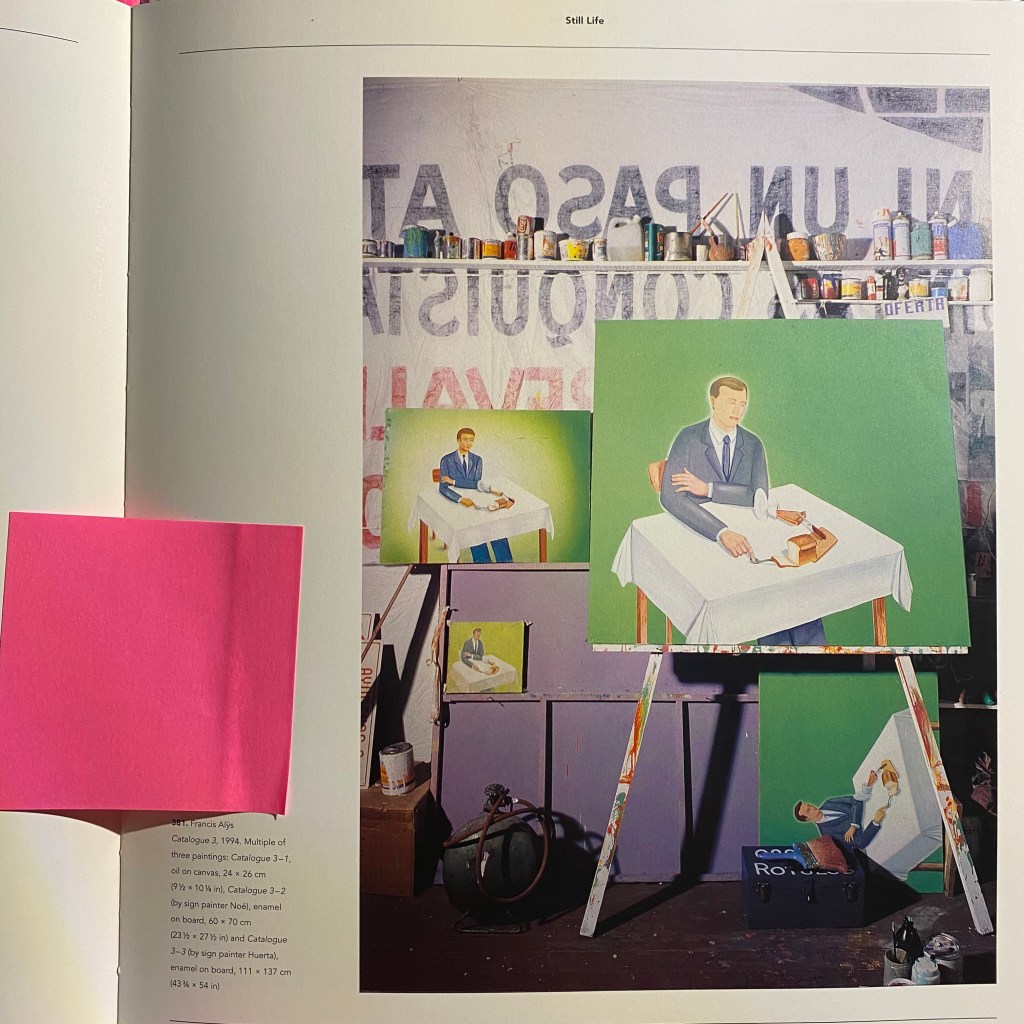
Catalogue 3, 1994/2009
So, Alÿs paints a man sitting at the table and hires some sign painters to paint copies of that painting. Once they are done, placed next to each other in the studio and photographed, Godfrey (2009, 341) decides to include that photograph into his survey of contemporary painting under the rubric of Still Life.
Well, Alÿs game here seems more or less clear – a Chinese whispers kind of regression/transformation of the painting, tickling of the concepts of authorship, originality and mass production. Myself, I tend to dip occasionally into regression (e.g. sound, but also in a series of digital copying and manipulations of a painting) and can make some ironic comments on originality and authorship once I get fed up with those issues still being dwelled upon by my peers.
Godfrey’s move is a more unexpected and peculiar one. How is this still life and why? A table with stuff on it – yeah, sure, but there is a man sitting there that kind of makes it a portrait or a domestic scene, no? Or is it a photograph of the objects that happen to be Alÿs paintings that is a still life – but the caption lists the actual paintings, suggesting that is it them Godfrey is considering. And the key feature of the work that Godfrey discusses is not some memento more or the composition of the food stuffs and utensils on the table, but the hiring of sign painters for reproductions. OK, perhaps I could disregard the figure as being some generic man (possibly comparable to a skull as a more typical element of still life) or even a possible foodstuff for some lurking predator. But a few pages down under the same rubric he also takes up Yoshimoto Nara’s “Good Charlotte/Riot Girl” – an animesque figuration of a girl being a single motif of the painting.
Well, perhaps they just made a good fit for the overall flow of his narrative. Yet, it is interesting that he (or was it his editors?) chose to use the traditional painting genres to structure his survey even if some works end up ill-fitting under their rubrics. Why is it so important to use those particular categories even when they appear far-fetched for the works being discussed? Is it something about habits that die hard, about institutional inertia? One of the key tenets in my critique of categories is that they are static representations of dynamic reality and therefore soon get incongruous and inadequate. And this move by Godfrey is an interesting example to consider in this context.
…on some level I am also wondering if Godfrey has “remade” Alÿs piece by making such classification. In that case it would become quite comparable to my “Colaborations” series.
References
Godfrey, Tony. 2009. Painting Today. London / NYC: Phaidon.
 s3685049