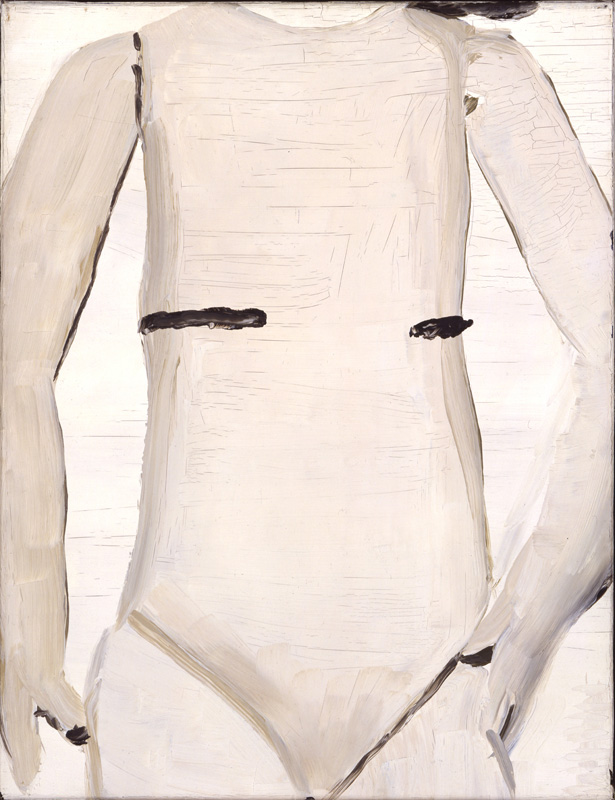
Luc Tuymans (b. 1958, Belgium)
Body, 1990
“I started out as a virtuoso painter with a great deal of gesturality and colour. That came to a crisis because it became a flaccid way of working – I found out that when one tried to cultivate a style, one misses the point and the necessities. So I tried to go to the other side, to be deliberately clumsy to research what kind of immediacy there is to that.” (Tuymans quoted in Godfrey 2009, 277).
Tuymans quote above is what got him on my list. I am also trying to escape style, go “to the other side”, perhaps even “to be deliberately clumsy” in a sense that I am trying not to polish my works too much, leave them a bit rough, a bit unjelled, a bit unarticulated. Two questions follow out of that – 1) Can I do that before having visited “this side”, without having been a virtuoso, without having had a style – is renouncement only allowed for those who have something that can be renounced? Who’s to decide? On what grounds? 2) Tuymans appears to have developed or maintained a recognisable style anyway – maybe “clumsy”, but recognisable. What went wrong? Is style police that efficient?
Otherwise, I find some relevance in his method as well – photographs turned into aquarelles turned into paintings with continued degradation of the detail in each step. I am intrigued with this deliberate controlled degradation that I have been testing both in painting (e.g. presenting them only as black and white heavily rasterised digital renditions) and in sound (tweaking original recordings until they are barely recognisable). I have a few hypotheses as to what that may be about, but I am far from certain still – that’s what makes it interesting to keep going.
References
Godfrey, Tony. 2009. Painting Today. London / NYC: Phaidon.
 s3685049