Hamish Fulton (b. 1946, UK)
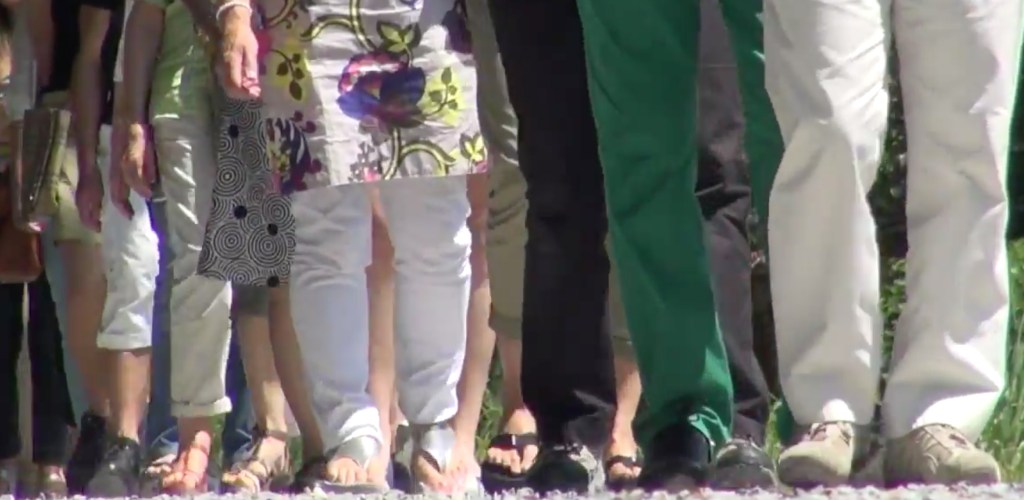
Limmat Art Walk, 2012
Last semester I listed an “Art Jog” among my artworks. I made it into a habit to go jogging between selected galleries, visiting each of them to see whatever they had on the show. My original motivation was “art won’t make me slim, jogging makes me bored – but what if I combine the two?” Then I noticed that along the way I was taking pictures that were feeding into my artsy series, I was generating artwork ideas (causing me occasionally to stop to write them down), I was experiencing art in the galleries, I was performing something with my body moving in space driven by artistic interests… I listed it among the artworks largely as a little provocation – to see if it would raise any eyebrows. It did not. Perhaps it was not even very outlandish among all the other things I had on the list. But I was still unsure if I truly considered it an artwork – that was not my intention from the outset (but, on the other hand, many of my works start that way), I did not have any audience (but, on the other hand, I ended up discussing my Art Jog with gallery attendants – so I kind of had some, anyway, not that it rendered anything really interesting, but still…; other gallery goers might also have had some thoughts seeing me there panting in my running gear…; it is also a question if presence of the audience is what defines an artwork)…
Anyway, once I discussed this with some people – including some of the gallery attendants – a references on running or walking as art started piling up. So, perhaps I was not totally off track…
Fulton highlights creation of an experience rather than an object as aim of his piece. This totally resonates with me, focusing on “artistic experience” and meanings generated within. Certainly, here he has done it very clearly for the audience – which is not exactly the case with my Art Jog.
Then the very slow walk in urban settings – that is something that I’ve been practicing as well, not being aware of any predecessors. But, also, without any audience participation or even knowing whether I had any and whether they would position my movements into a category of art. I could occasionally register curious gazes though, and could imagine an aesthetic effect of the contrast in dynamics with the surrounding urbanities, traffic, hurried passers-by etc.
Yeah, I don’t really know where I am standing on this. I totally recognise importance of body movement for my practice – both in terms of wellbeing and idea generation and aesthetic form. To what extent I want to push it to be framed as artwork in itself remains to be seen, but examples like Fulton provide some context and food for thought.
 s3685049