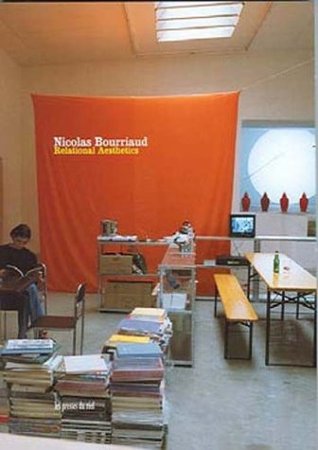
Nicolas Bourriaud (b. ; France)
Relational Aesthetics, 1998
OK, let’s throw in some texts that I love to misinterpret.
Relational Aesthetics is one them. Bourriaud addresses artistic trends of the 1990s, seeing focus on social relations as a novel key source of inspiration as well as artistic medium. It’s all good, but the only thing I really really really like is definition of art as “state of encounter”. And I am certainly reading it in the way that inspires me and my practice rather than how Bourriaud may have meant it.
I suspect that Bourriaud had his eyes on encounters between humans, while my focus is on encounter of a human with an artwork – whatever form or shape it may have. I am thinking that art (at least the kind of art that I am most interested in) is not in the artwork, artistic intention or institutional consecration, but in that particular instance of engagement of the viewer with the artwork. Not just any engagement, but a rather particular state of encounter that sometimes happens, and sometimes does not. I may look at Mona Lisa among all the flashlights and see no art whatsoever, I can walk by a poorly overpainted graffiti and suddenly stop in awe appreciating shifts in colours, odd emerging shapes, streams of associations to other (“real”) artworks etc… Then next time the magic may be gone, art is just not happening.
And I am painfully aware that my reading is not very coherent logically and not very functional as definition, as it gives no clear outline, no rule – and also is based on some circular references (“it’s art when you know it’s art” kind of thing) that are based on certain traditions, yet arbitrarily deviate from them. But hey, it’s not a natural science, and it is the best I can do at the moment. The main point is that I am willing to shift emphasis from the object, from the artist, from the institution to that evasive artistic experience in encounter between a potential artwork and potential viewer – that sometimes happens and sometimes not.
Then again, I do like to stage situational works that are primarily built on audience participation. So my practice does have even more “conventional” connection with Bourriaud. But he seems to search in art for models for social interaction that might have wider implications even outside of the artistic contexts – and there he looses me again. I associate models to normativity and I am allergic to norms… I mean, it is insane to draw a line between art and life to start with, they are part of each other anyway, so I certainly do not have any problems with ideas and actions circulating freely between the two. But any attempt to position art as a think tank for social change makes it just too instrumental for me, leading to a visceral reaction to reject it. If I wanted to make deliberately functional projects as my main goal, I’d be doing design, not art…
 s3685049